After around 16 years of walking the Camino since 2010 – I’m writing this in 2026 – and countless kilometres of long-distance hiking, I’ve tried pretty much every way of keeping the rain out: waterproof jackets, rain trousers, traditional ponchos, ultralight ponchos and various hybrids in between.
My conclusion?
The best poncho for the Camino doesn’t really look like a poncho at all.
It looks more like a long Western-style raincoat, with a hood and enough extra room at the back to cover your backpack.
Why? It’s quite simple.
Do you actually need a poncho?
No.
A waterproof jacket works perfectly well, too. But if we’re going to compare weights, we should compare them fairly:
Waterproof jacket + rain trousers + backpack cover versus poncho.
Suddenly, 500 or 600 grams for a decent poncho doesn’t seem quite so excessive.
And a poncho solves the whole problem in one go: pilgrim dry, backpack dry, keep walking.
A good rain poncho is also surprisingly useful away from the Camino. Simply because it works.
The cut: The problem with the traditional poncho
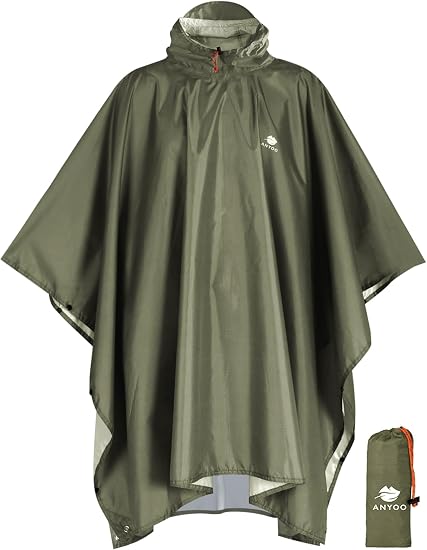
A traditional poncho is essentially a large rectangle with a hole for your head.
Brilliantly simple.
Until the wind picks up.
Then you turn into a walking sail.
Many traditional ponchos also stop somewhere around the elbow. Your fleece sticks out underneath – and sooner or later, it gets wet.
Ventilation can be rather theoretical, too. All that heat and moisture is somehow expected to escape through a small zip at the neck.
Good luck with that.
That’s why I prefer a long, generously cut raincoat with proper sleeves, a hood and enough extra room at the back to cover a backpack.
Less flapping in the wind, dry arms, full freedom of movement – and the long front zip alone gives you far more control over ventilation.
For me, it’s simply the better design. Full stop.
The fabric: How much rain does it need to handle?
This is where you can start comparing hydrostatic head ratings and working your way through technical data sheets.
You can.
But you don’t have to.
For practical purposes, one simple observation gets you surprisingly far:
Very light, very durable and reliably waterproof for hours of continuous rain – getting all three at once is difficult.
Modern lightweight fabrics can be remarkably waterproof. But fabric weight, coatings, construction and durability still matter. And sooner or later, those things tend to show up on the scales.
An ultralight ripstop poncho may therefore be exactly the right choice if what you want is emergency protection for the occasional shower.
But if your attitude is, It’s been raining for four hours. So what? I’m still walking, then a little more material and a little more margin for bad weather shouldn’t automatically be dismissed as unnecessary weight.
In short:
The lighter the poncho, the more clearly you should know what you expect it to do.
Ventilation: Waterproof isn’t enough
Because when you’re hiking, water comes from two directions.
From above, as rain.
And from inside, as sweat and condensation.
Walk uphill with a backpack and your body produces plenty of heat and moisture. If that moisture has nowhere to go, your poncho may keep the rain out perfectly – and you’ll still end up wet underneath.
That’s why ventilation is at least as important as waterproofing.
A long, full-length front zip makes a huge difference. Better still are additional underarm zips. You can often leave them open even in the rain, allowing a surprising amount of heat and moisture to escape.
Squaring the outdoor circle
So now we have the basic ingredients of a good Camino poncho:
a practical cut, waterproofing, good ventilation, durability – while still keeping the weight down.
Ideally, all of that would weigh 180 grams.
Good luck.
Somewhere, there has to be a compromise. In practice, more protection from the elements, greater durability and more confidence in prolonged rain usually mean carrying more weight.
Two different real life poncho-models illustrate that trade-off rather clearly. They aren’t the only good options, but they make useful reference points:
Altus Atmospheric J30: around 300 grams, with a long cut, proper sleeves and extra room for the backpack. Nicely lightweight, but with less ventilation around the arms and therefore a greater tendency for condensation to build up inside.
Decathlon MT900: around 600 grams, based on the same general long-coat design, with sleeves and room for the backpack, but with additional underarm zips and a heavier, more robust construction for prolonged bad weather.
Both have another very practical advantage:
Thanks to the long front zip, you can take them off at the front while leaving the back draped over your backpack. They can simply hang there, drip dry and wait for the next shower.
With a traditional poncho, sooner or later the question becomes: What do I do with this wet thing now? With a waterproof jacket: Backpack off – preferably without putting it straight into the nearest puddle.
The Altus and MT900 can simply stay hanging over the back of your pack.
Extremely useful in classic Camino weather:
Rain. Sun. Rain. Sun. Rain.
So which one is right?
That’s actually the wrong question.
Because when you pack your backpack, you have no idea what the weather (over Galicia) will be doing two weeks later.
So you’re always making a decision under uncertainty. Just as we do with so many things in life: We know the past, not the future – and St Peter still isn’t answering WhatsApp messages.
There is no single objectively correct choice.
It’s a decision about risk.
Walking in summer and expecting mostly good weather with the occasional shower?
I might save the 300 grams and take the Altus Atmospheric J30.
Walking in spring, autumn or winter, when prolonged periods of rain are more likely?
I’d accept the extra 300 grams and take the MT900.
And if I could own only one poncho for walking the Camino all year round?
MT900.
The takeaway: It’s actually quite simple
Both ponchos as examples are very good choices.
More importantly, both use the basic design that, after all these years, I consider particularly well suited to the Camino.
Not the classic flapping rectangle, but something closer to a Western coat for pilgrims: long cut, hood, proper full-length sleeves, enough room for the backpack and a long front zip.
For me, there isn’t much left to debate about the basic design.
The real decision comes afterwards:
How much protection do I want in reserve – and how many grams am I willing to carry for it?
Altus Atmospheric J30: roughly 300 grams less. Nice and light, but with less ventilation, more condensation and less protection in reserve when a passing shower turns into an entire day of rain.
Decathlon MT900: roughly 300 grams more. In return, you get better ventilation through the underarm zips, a more robust construction and more confidence when you’re walking for hours in continuous rain.
That’s really all you need to know.
Summer, mostly good weather expected, every gram matters? Altus.
Spring, autumn, winter – or simply no desire to let the rain dictate your day? MT900.
And if I simply don’t know what to expect?
Personally, I’ll carry the extra 300 grams.
Perhaps I’ll carry them completely unnecessarily for 500 kilometres across Spain.
That would be by far my favourite outcome.