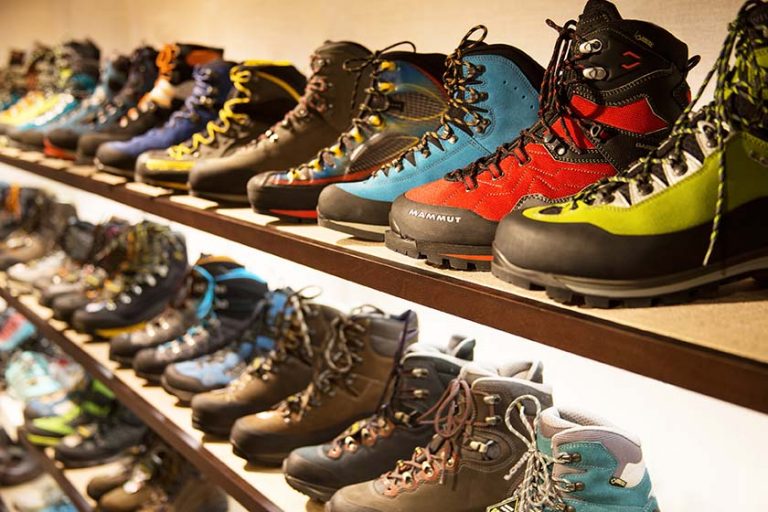
Hiking boots or lightweight hiking shoes? Trail runners or Gore-Tex? High ankle support or low-cut shoes?
Few questions occupy future pilgrims as much as choosing the right footwear. And few questions are answered with such wonderfully simple advice:
“Definitely take hiking boots.”
Or:
“Trail runners are much better.”
Both can be right.
And both can be completely wrong for you.
Because there is no single perfect Camino shoe. What matters is which shoe suits your feet, your body, your backpack, your route and the time of year you are walking.
So this article is not about particular brands or models. Instead, we will look at the things that actually matter:
- Why the weight of your shoes matters more than many people realise.
- How much stability you really need.
- Why fit matters more than brand or price.
- How much room your feet need on long walking days.
- When waterproof shoes make sense — and when they do not.
- Why socks are part of the footwear system.
- And how to recognise hot spots and prevent many blisters before they even develop.
By the end of this article, you should not know which shoe we would buy.
You should know how to find the right shoe for you.
REMEMBER: The Most Important Rule
As light as possible — as stable as necessary.
If you remember only one idea from this article, make it this one.
1. Why the Weight of Your Shoes Matters
Pilgrims can become remarkably serious about saving weight.
The large towel stays at home. Toothpaste gets transferred into a smaller tube. A 400-gram jacket is replaced by one weighing 250 grams.
And then we put a pair of heavy hiking boots on our feet.
There is, however, a difference between where we carry weight.
Something in your backpack sits relatively quietly on your body. A shoe, on the other hand, has to be moved with every single step.
And you take quite a few of those on the Camino.
On a 25-kilometre day, 30,000 steps is perfectly possible. Walk for several weeks and you will move your shoes hundreds of thousands of times.
The fact that this costs energy is not exactly a new discovery. Back in the 1980s, the British Army Personnel Research Establishment studied the energy cost of walking in heavy boots.
And if anyone has some practical experience with long marches and heavy footwear, the military is probably a reasonable place to look.
The basic result was straightforward:
More weight on your feet costs more energy.[1]
That does not mean you need to take kitchen scales to the shoe shop.
It simply means:
Weight your shoe does not need is weight you do not need to carry along the Camino.
REMEMBER: Every Gram Moves With You
A difference of 100 or 200 grams per shoe may not sound like much.
But you are not simply carrying that weight.
You are moving it with every step.
Over hundreds of thousands of steps, that matters.
But: lightness is not an end in itself. If you need more stability, the extra weight serves a purpose.
2. Do I Even Need Hiking Boots for the Camino?
That depends first of all on which Camino you are walking.
Large parts of the Camino Francés and Camino Portugués consist of asphalt, dirt tracks, forest paths, gravel and reasonably well-maintained trails.
Of course, there are rocky, steep and difficult sections. Some Caminos and alternative routes are considerably more demanding than others.
But a typical Camino is not a multi-week high-altitude mountaineering expedition.
Many pilgrims also carry relatively light backpacks these days.
For a healthy and experienced walker, lightweight hiking shoes or trail-running shoes can therefore be perfectly adequate.
Other people feel much safer in a more supportive hiking shoe.
And that is exactly the point.
Not:
“What do people wear on the Camino?”
But:
“What do I need on my Camino?”
3. How Much Stability Do You Need?
If you walk regularly, have stable feet and ankles and carry a light pack, you probably need less support.
Things may look different if you:
- often roll your ankles,
- have known foot or ankle problems,
- have little hiking experience,
- carry a heavy backpack, or
- are planning a particularly demanding route.
In those cases, a more supportive shoe may make sense.
The same applies to ankle height.
A high collar can feel supportive and secure. But high does not automatically mean stable. The sole, fit, lacing and overall construction of the shoe matter as well.
Research also gives us little reason to accept the simple formula “high-top shoe = automatically more ankle stability”.[2]
REMEMBER: Only as Much Shoe as You Need
Do not simply buy the lightest shoe you can find.
Choose the lightest shoe that still gives you enough security and stability.
For one person that may be a trail runner.
For another, a sturdy hiking shoe.
Both may have made exactly the right choice.
4. Brand Comes Second — Your Foot Comes First
This may be the most important section in the entire article.
People have different feet.
Some have a wide forefoot, others a narrow one. Some have narrow heels, high insteps or particularly long toes.
That means a shoe with outstanding reviews can still be completely wrong for you.
And a model your friend wore happily for 800 kilometres may give you your first blister after 20.
The shoe has to fit your foot — not the other way around.
Room at the front is especially important.
During long days of walking, feet get warm, loaded and may swell. On descents, the foot also tends to slide forwards.
If your toes are already touching the front of the shoe in the morning, things are unlikely to improve after several hours.
You therefore need enough room in the toe box.
At the same time, your heel should sit securely and not lift noticeably with every step.
And Where Should You Buy Your Shoes?
Of course you can buy hiking shoes online.
If you already know a brand, its last and perhaps even the exact model, and you know it fits your foot, there is little reason not to.
For a first purchase, the situation is different.
A good specialist hiking or outdoor shop with a broad selection of different brands is difficult to replace.
An experienced salesperson will not just look at the number on the box. They can often tell whether you have a wide or narrow foot, how your heel sits, what type of last may suit your foot and which models are worth trying in the first place.
And just as importantly, a multi-brand shop lets you compare different shapes.
That may matter far more than saving €20 or €30 online.
If you are going to walk several hundred kilometres in a pair of shoes, good advice is probably one of the more sensible things you can spend money on.
REMEMBER: Buy for Your Foot — Not for the Discount
Already know the manufacturer, last and model? Buying online may be perfectly fine.
Not sure?
Find a good hiking or outdoor specialist with a large selection and several brands.
A good salesperson can easily be worth the extra money — especially if, 300 kilometres later, you still enjoy putting your shoes on in the morning.
5. Should Hiking Shoes Be One Size Bigger?
You hear this advice all the time:
“Always buy hiking shoes one size larger.”
As a reminder to allow enough room, it is understandable.
As a fixed rule, it is not particularly useful.
A size 44 can fit very differently between manufacturers and even between models from the same brand.
So the number on the box is not what matters.
The actual space inside the shoe is.
If possible, do not try your shoes only first thing in the morning. Your feet are often a little larger later in the day.
Wear the socks you intend to use on the Camino.
And test what happens when you walk downhill.
Your toes should not repeatedly hit the front of the shoe.
REMEMBER: Not “One Size Bigger”
The better rule is:
Enough room for a warm, loaded foot — without letting the foot slide around inside the shoe.
6. Gore-Tex or a More Breathable Shoe?
There is a wonderful Camino answer to this question:
It depends.
When are you going?
Where are you going?
And what kind of weather are you likely to encounter?
A waterproof shoe can be very comfortable during a passing shower. It can also be useful when walking through wet grass in the morning or in cold, damp conditions.
But waterproof does not automatically mean your feet will stay dry.
Your feet produce heat and sweat while walking. A highly breathable shoe allows that moisture to escape more easily.
In prolonged rain there is another problem: water can enter from above, running down your legs and socks.
And once a waterproof shoe becomes properly wet on the inside, it usually dries more slowly than a lightweight, breathable shoe.
That is why, especially in summer, it can make perfect sense to wear a shoe that is allowed to get wet — but dries quickly afterwards.
In a cold spring or autumn, the answer may be exactly the opposite.
REMEMBER: Waterproof or Not?
Short showers, wet grass, cold weather:
A waterproof membrane can be very useful.
Summer and heat:
A breathable shoe may be more comfortable and dry more quickly.
Hours of continuous rain:
Even in waterproof shoes, your feet can eventually become damp or wet — from sweat or from water entering from above.
Season, temperature and expected weather all matter.
7. Moisture and Blisters — Studied on the Camino Itself
Wet feet are not just uncomfortable.
Moisture together with repeated mechanical stress is a poor combination for the skin and plays an important role in blister formation.[3]
And this has actually been studied in a particularly relevant place:
on the Camino de Santiago itself.
Researchers examined 203 pilgrims from 22 countries staying in hostels along the Camino Francés. On average, the participants had already walked around 254 kilometres.
68.5% had foot blisters.
One result was particularly interesting: pilgrims whose socks were wet at the end of the day had a 1.94-times higher risk of blisters in this study.[4]
And there was another useful finding.
Whether the socks were mainly made from natural or synthetic fibres was not significantly associated with blister occurrence.
In other words:
Before we start arguing about whether Merino, synthetic fibres or the latest miracle material is the one true sock, it may be worth concentrating on something more basic:
keeping our feet reasonably dry.
REMEMBER: Dry Socks Matter More Than Sock Religion
The Camino study found no decisive difference between mainly natural and mainly synthetic fibres.
Wet socks, on the other hand, were associated with almost twice the blister risk.
So on a long stage, carrying a simple spare pair of socks may be a very sensible idea.
8. Do Camino Shoes Need to Be “Broken In”?
With traditional heavy leather boots, breaking them in certainly made sense.
With modern hiking and trail-running shoes, however, you should be cautious when a salesperson says:
“Don’t worry, they always hurt a bit at first. They’ll break in.”
A modern shoe should fit reasonably well from the beginning.
That does not mean you should start a long Camino in completely untested footwear.
Because above all, you need to get to know the shoe.
Take it on several longer walks before your trip.
Even better: walk longer distances on two consecutive days.
That is when you discover what happens after 15, 20 or 25 kilometres.
Perhaps everything works perfectly.
Or perhaps a small area on your heel starts rubbing after three hours.
Which brings us to one of the most important subjects of all.
9. Blisters Usually Give You Warning
Many pilgrims treat blisters as if they were simply part of doing the Camino.
They do not have to be.
A blister usually does not appear out of nowhere.
Quite often, you feel something first.
A spot becomes unusually warm.
It starts to sting.
A toe begins to rub.
Or suddenly you become aware of your heel with every step.
That is a hot spot.
And now comes one of the most important rules for preventing blisters:
Stop immediately.
Do not think:
“The next bar is only another three kilometres.”
Three kilometres still means thousands of steps — and therefore thousands of additional movements over exactly the same irritated patch of skin.
Backpack off.
Shoe off.
Sock off.
Have a look.
Maybe there is sand in your shoe. Perhaps the sock has folded. Perhaps your skin is damp. Perhaps the area is already slightly red.
At this point, you can still do something about it.
REMEMBER: A Hot Spot Is a Warning
Warm. Stinging. Rubbing. Different.
Do not ignore it.
Stop and investigate.
Five minutes now may save you several painful days later.
10. Paper Tape: Cheap, Light and Surprisingly Useful
If you notice a hot spot early, you can protect the affected area.
One very simple method is medical paper tape.
It almost sounds too basic to be scientifically interesting.
But this very method has actually been tested on people who arguably ask even more of their feet than most pilgrims do: participants in multi-day 250-kilometre ultramarathons.
A randomised trial involving 128 runners looked at paper tape applied to blister-prone areas.
The result:
Paper tape reduced the occurrence of foot blisters.[5]
A small roll weighs next to nothing, costs very little and takes up hardly any space.
For us, that makes it a very sensible item in a Camino first-aid kit.
But paper tape cannot fix a badly fitting shoe.
If the same spot gives you trouble every day, find out why.
REMEMBER: Tape Early — Not Late
Paper tape is most useful before a blister has formed.
If you feel a hot spot:
Stop → check → dry → remove the cause → tape if necessary.
11. How Much Cushioning Do I Need?
You may end up walking more asphalt on the Camino than you expected.
Good cushioning can feel very pleasant there.
That is one reason why modern trail-running shoes with generous cushioning appeal to many pilgrims.
But once again:
More is not automatically better.
Very soft, high-stack shoes may feel wonderful on asphalt but quite different on uneven ground.
Other people love exactly those shoes and happily walk hundreds of kilometres in them.
So there is only one real way to find out.
Try them.
Not for five minutes in a shop.
For several hours outdoors.
12. When Does a Lightweight Shoe Make Sense?
A lightweight hiking shoe or trail runner may be particularly suitable if you:
- have healthy, stable feet and ankles,
- carry a relatively light backpack,
- spend most of your time on normal Camino paths,
- are walking in relatively warm weather, and
- already have experience with longer hikes.
In that situation, there may be little reason to carry a heavy trekking boot.
13. When Might a More Supportive Shoe Be Better?
A sturdier shoe may be the better choice if you:
- frequently roll your ankles,
- have known foot or ankle problems,
- feel noticeably safer in a supportive shoe,
- carry a heavy backpack,
- have little hiking experience, or
- expect demanding terrain or poor weather.
In that case, the extra weight is doing a job.
A heavy shoe is not bad. It should simply not be heavier than necessary.
14. What About Hiking Sandals?
Of course, it is possible to walk a Camino in sandals.
Some experienced pilgrims do exactly that.
The important question is what your feet are used to.
If you have walked long distances in hiking sandals or minimalist footwear for years, that is very different from deciding to try them three weeks before your Camino.
Your feet and muscles adapt to the footwear you use.
The Camino is therefore not an ideal place for a completely new experiment.
Start with a system you already know works for you.
15. So Which Shoe Should We Recommend?
After such a long article, you may now be expecting a list of ten recommended models.
You are not going to get one.
Deliberately.
Models change. Manufacturers alter their shoes. A test winner may be too wide, too narrow, too soft or too stiff for your foot.
What matters far more is that you can now judge for yourself what you actually need.
And perhaps that is the best shoe advice of all:
Do not look for the shoe everyone else recommends.
Look for the shoe that fits you.
The Most Important Points at a Glance
The Right Camino Shoe
As light as possible — as stable as necessary.
Extra weight on your feet costs energy. Do not carry more shoe than you need.
Your foot decides — not the brand.
Pay particular attention to forefoot width, toe room and secure heel hold.
Good advice can be worth paying for.
If you do not yet know which lasts suit your feet, visit a good multi-brand hiking or outdoor specialist.
Allow room for long days.
Your feet may swell over the course of a long stage. Your toes must not hit the front, especially on descents.
Waterproof or breathable? It depends.
Temperature, season and expected weather all matter.
Shoes and socks work as a system.
And dry socks matter more than whether the label says natural or synthetic fibres.
Test new shoes — do not simply hope they will eventually fit.
Take them on several long walks before your Camino.
Never ignore a hot spot.
If somewhere feels warm, starts to sting or begins to rub: stop.
Paper tape can help prevent blisters.
Applied early to a developing hot spot, simple medical paper tape can help protect the skin.
And If You Remember Only One Sentence:
The best Camino shoe is not the lightest, most supportive or most expensive one — it is the lightest shoe that gives your feet enough room, support and protection for your Camino.
Sources & Further Reading
[1] Legg SJ, Mahanty A. Energy cost of backpacking in heavy boots. Ergonomics. 1986;29(3):433–438. DOI: 10.1080/00140138608968276.
Study examining the additional energy cost associated with heavy footwear while walking with a backpack.
[2] Jiang C. The Effect of Basketball Shoe Collar on Ankle Stability: A Systematic Review and Meta-Analysis. Physical Activity and Health. 2020;4(1):11–18. DOI: 10.5334/paah.48.
Systematic review examining whether higher shoe collars automatically provide greater ankle stability.
[3] Rushton R, Richie D. Friction Blisters of the Feet: A Critical Assessment of Current Prevention Strategies. Journal of Athletic Training. 2024;59(1):8–21. DOI: 10.4085/1062-6050-0341.22.
Recent review of foot-friction blister formation and prevention.
[4] Chicharro-Luna E, Gijon-Nogueron G, Sanchez-Rodriguez R, Martínez-Nova A. The influence of sock composition on the appearance of foot blisters in hikers. Journal of Tissue Viability. 2022;31(2):315–318. DOI: 10.1016/j.jtv.2022.02.002.
Study of 203 pilgrims from 22 countries on the Camino Francés. Wet socks were associated with a 1.94-times higher blister risk, while predominantly natural versus synthetic fibre composition was not.
[5] Lipman GS, Sharp LJ, Christensen M, et al. Paper Tape Prevents Foot Blisters: A Randomized Prevention Trial Assessing Paper Tape in Endurance Distances II (Pre-TAPED II). Clinical Journal of Sport Medicine. 2016;26(5):362–368. DOI: 10.1097/JSM.0000000000000319.
Randomised trial involving 128 participants in multi-day 250-kilometre ultramarathons, examining paper tape for blister prevention.