Maybe That’s the Wrong Question.
Small sips or big gulps?
Half a litre every hour?
Three litres a day?
Drink before you’re thirsty?
Only when you’re thirsty?
Water?
Electrolytes?
If you’ve ever searched for advice on hydration, you’ll know that something as simple as drinking water can become surprisingly complicated.
There are formulas.
There are schedules.
There are apps.
There are people on YouTube who appear to have discovered the correct number of millilitres for the entire human species.
And, to be fair, many of the ideas behind all this advice aren’t complete nonsense.
Hydration matters.
How much you drink matters.
When you drink can matter.
Heat matters.
Sweating matters.
Electrolytes can matter.
But by the end of this article, we’re going to arrive at a rather simpler question.
Not:
Exactly how much should I drink?
But:
When my body wants water, how easy have I made it to actually drink some?
Because for many walkers, hydration eventually becomes less a question of physiology than a question of availability.
Or, put another way:
friction.
Keep that thought in mind.
We’ll come back to it.
There's no single "correct" hydration number. Sweat rate, weather and terrain all change daily. Your best strategy is listening to your body, and removing the friction that stops you from acting on what it tells you.
First: does drinking really make that much difference?
Yes.
But perhaps not in the way we usually think about it.
You don’t need to become dangerously dehydrated and collapse theatrically beside a yellow Camino arrow before insufficient fluid starts affecting your day.
As dehydration increases, cardiovascular strain increases, temperature regulation becomes harder and endurance performance can suffer. A fluid deficit of around 2% of body mass is commonly used in sports medicine as a level at which these effects become increasingly relevant, particularly in warm conditions.[1]
For a 70 kg person, that’s about 1.4 kg.
Quite a lot of missing water.
But on the Camino there is another aspect that matters just as much.
Tomorrow.
A marathon runner can cross the finish line completely exhausted.
That’s fine.
The race is over.
You don’t have that luxury.
Tomorrow morning, somebody is going to put your backpack next to your bed again.
Unfortunately, that somebody is you.
A Camino isn’t one long walk.
It’s a collection of walking days.
Today’s effort becomes tonight’s recovery, and tonight’s recovery becomes tomorrow morning’s starting point.
Arrive reasonably hydrated, eat, drink, rest and you’re giving yourself a better chance of waking up ready to go again.
Arrive depleted every afternoon and spend the evening trying to catch up, and you’re making recovery unnecessarily difficult.
And then you repeat the whole thing.
Day.
After day.
After day.
It’s Groundhog Day with walking poles.
So perhaps good hydration isn’t really about squeezing another 4% of performance out of today’s stage.
It’s about arriving in a condition that makes tomorrow feel like another walking day rather than an unfortunate administrative obligation.
Fine. So how much should I drink?
Ah.
Now we reach the part where everybody would like a number.
Two litres?
Three?
Four?
500 ml per hour?
Wouldn’t that be convenient?
Unfortunately, your body hasn’t read the guidelines.
People have very different sweat rates. And even your own requirements aren’t constant.
A hot day across the Meseta isn’t a cool morning in Galicia.
Twenty-eight kilometres aren’t fourteen.
A steep climb isn’t a riverside stroll.
Thirty-two degrees aren’t seventeen.
Temperature, humidity, body size, clothing, pace, acclimatisation, terrain and individual sweat rate all affect how much fluid you lose.
That’s why serious sports-medicine guidance doesn’t give one magic quantity for everyone. The American College of Sports Medicine recommends individualising fluid replacement instead.[1]
So if someone confidently tells you that every pilgrim needs exactly three litres a day, you can safely ask:
Which pilgrim?
And:
Which day?
All right. Small sips or big gulps?
Another wonderfully simple question with an annoyingly complicated answer.
You’ve probably heard that the human body can only absorb small amounts of water at a time.
Therefore you should supposedly take a few little sips every ten or fifteen minutes.
It sounds very scientific.
The actual physiology is less cooperative.
The rate at which fluid leaves the stomach depends on several factors, including volume, composition, carbohydrate concentration and exercise intensity. Larger volumes in the stomach can initially even increase gastric emptying.[2]
So there isn’t good evidence for a universal rule saying that tiny, perfectly timed sips are inherently superior.
That doesn’t mean ignoring water for three hours and then pouring a litre into yourself is particularly clever either.
There is a much less exciting solution:
Drink regularly.
Sometimes you’ll want two sips.
Sometimes you’ll want six.
Sometimes you’ll stop at a fountain and have a proper drink.
Remarkably, this does not require an app.
But shouldn’t I drink before I’m thirsty?
This is probably one of the most persistent pieces of hydration advice.
If you’re thirsty, it’s already too late.
It sounds alarming enough to be memorable.
It just isn’t that simple.
Thirst is one of the mechanisms your body uses to regulate fluid balance. Modern sports-medicine guidance is much more nuanced than the old idea that thirst is somehow an unreliable emergency warning that only activates after disaster has already begun.
The international consensus on exercise-associated hyponatraemia considers drinking according to thirst a sensible strategy in many endurance situations.[3]
Which makes intuitive sense.
Your body has been regulating water balance for considerably longer than sports-drink manufacturers have been producing lemon-flavoured tablets.
Does that mean you should wait until your tongue resembles sandpaper?
Of course not.
It means:
Notice what your body is telling you.
Thirsty?
Drink.
Very hot day?
Pay more attention.
Sweating heavily?
Your requirements are probably higher.
Cool morning and barely sweating?
Perhaps they’re lower.
Urine unusually dark and scarce?
Worth noticing.
Feeling fine, drinking normally and not particularly thirsty?
Perhaps you don’t need to force another bottle into yourself just because somebody’s hydration calculator says you are 286 ml behind schedule.
Your body isn’t a laboratory instrument.
But it’s a surprisingly useful one.
And it comes free with every Camino.
Can I actually drink too much?
Yes.
This surprises people because the logic seems so obvious:
Water is good.
Therefore more water must be better.
Unfortunately, biology doesn’t offer volume discounts.
During prolonged exercise, consuming substantially more fluid than you lose can dilute the sodium concentration in the blood. This is called exercise-associated hyponatraemia, and severe cases can be dangerous.[3]
So hydration isn’t a competition.
The objective isn’t:
Drink as much as possible.
It’s:
Give your body roughly what it needs.
Which, once again, depends on you and the conditions.
And what about electrolytes?
Useful.
Sometimes very useful.
But not magic.
We obtain sodium and other electrolytes from ordinary food. During long periods of exercise, especially in heat and with substantial sweating, replacing sodium becomes more relevant. Sports-nutrition guidance commonly discusses drinks containing around 0.5 to 0.7 g of sodium per litre for prolonged exercise situations.[5]
So on a long, hot, sweaty Camino stage, electrolytes may make perfectly good sense.
On a cool, easy morning followed by tortilla, bread, cheese and olives at lunch, your body isn’t necessarily facing an electrolyte apocalypse.
And electrolyte tablets don’t make excessive drinking harmless.
Adding minerals to far too much water is still far too much water.[3]
Again, circumstances matter.
So after all this science, what do we actually know?
Something surprisingly useful.
There isn’t one correct amount.
There isn’t one correct drinking interval.
There isn’t one correct bottle.
There isn’t one correct electrolyte strategy.
But there is a pretty good feedback system.
You.
Your thirst.
Your sweating.
The weather.
Your effort.
How you feel.
How you’re recovering.
And the experience you accumulate from one walking day to the next.
After a few days on the Camino, you often begin to understand your body remarkably well.
Yesterday was hot. I needed much more.
Today is cooler. I’m fine.
That long climb made me drink a lot.
I arrived yesterday completely drained. Maybe I left it too late.
That’s not unscientific.
That’s learning.
And this is where we finally come back to the question from the beginning.
Because there is one small problem.
You can only listen to your body if you make it easy to answer
Imagine this.
You’re walking.
You’re thirsty.
You have water.
Perfect.
Where is it?
Behind you.
In your backpack.
Ah.
Now you have to stop.
Take off the backpack.
Open it.
Find the bottle.
Drink.
Put the bottle back.
Close the backpack.
Put it on again.
Nothing dramatic.
Thirty seconds, perhaps.
But you’re walking nicely.
So you think:
I’ll do it in a minute.
A kilometre later:
At the next fountain.
Then you start talking to somebody.
Then the trail gets beautiful.
Then there’s a hill.
Then the fountain doesn’t work.
Then the café you were expecting is closed.
And suddenly it’s ninety minutes later.
You had water all along.
You simply didn’t drink it.
That’s not really a hydration problem.
It's a Friction Problem.
And suddenly all those complicated questions about drinking become rather more interesting.
Because perhaps the most useful thing you can do isn’t calculating exactly how many millilitres you should consume every seventeen minutes.
Perhaps it’s simply removing the obstacle between:
I’m thirsty
and
I drink.

Make drinking frictionless
Water shouldn’t merely be with you.
It should be available to you.
There is a difference.
If your bottle is somewhere in your backpack, you have water.
If your bottle is within easy reach while you’re walking, you have access to water.
And access changes behaviour.
Hydration research recognises that drinking behaviour is influenced not only by physiological need but also by the availability and accessibility of fluids.[6]
Which brings us to perhaps the simplest hydration strategy in this entire article.
Make the right thing the easy thing.
Feel thirsty.
Reach for bottle.
Drink.
Put it back.
Keep walking.
Five seconds.
No backpack.
No stopping.
No decision.
No I’ll do it later.
No friction.
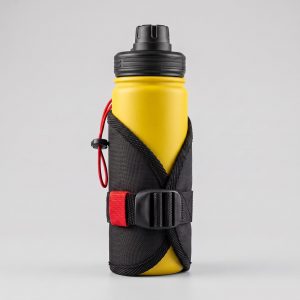
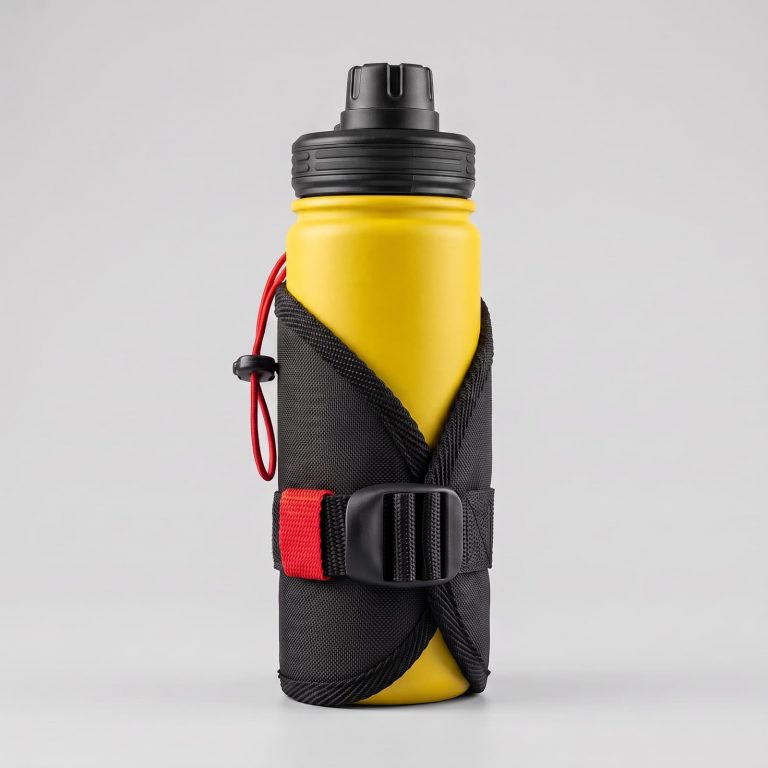
Keep water within reach. Our Bottle Holder clips to any strap so your bottle stays within reach. No backpack, no stopping, no talking yourself out of it.
Shop the Bottle Holder Keep water within reach. Our Bottle Holder clips to any strap so your bottle stays within reach. No backpack, no stopping, no talking yourself out of it.
Open the PopupAnd that small difference can matter enormously over six or eight hours of walking.
Not because a bottle holder magically hydrates you.
You still have to drink.
But because it removes one surprisingly effective little reason not to.
And that’s really the point.
There is no perfect hydration formula for the Camino.
There can’t be.
You are different from the person walking beside you.
Today is different from yesterday.
Tomorrow will be different again.
But you can make it easier to respond to those differences.
Listen to your body.
Keep enough water with you.
And above all:
keep it within reach.
The goal isn’t to arrive having perfectly followed somebody else’s hydration schedule.
The goal is much simpler.
Arrive reasonably fresh.
Recover.
Sleep.
Wake up.
Put on your shoes.
Pick up your backpack.
And be ready to do it all again.
Sometimes the smartest optimisation isn’t another number.
It’s simply removing the obstacle.
Sources
[1] Sawka MN et al. American College of Sports Medicine position stand: Exercise and fluid replacement. Medicine & Science in Sports & Exercise. 2007;39(2):377 to 390.
[2] Research on gastric emptying and fluid replacement during exercise, including the influence of gastric volume on gastric emptying.
[3] Hew-Butler T et al. Statement of the Third International Exercise-Associated Hyponatremia Consensus Development Conference, Carlsbad, California, 2015. British Journal of Sports Medicine. 2015;49:1432 to 1446.
[4] McDermott BP et al. National Athletic Trainers’ Association Position Statement: Fluid Replacement for the Physically Active. Journal of Athletic Training. 2017;52(9):877 to 895.
[5] International Olympic Committee and sports-nutrition guidance concerning hydration and sodium replacement during prolonged exercise.
[6] Hydration literature concerning thirst, beverage availability, accessibility and drinking behaviour.