Why We Walk
People have been walking to Santiago de Compostela for more than a thousand years.
They once came primarily as pilgrims, travelling across medieval Europe towards the supposed resting place of the Apostle Saint James. They came from Portugal and France, from Germany and Italy, from Britain and the Low Countries. Roads developed beneath their feet. Bridges were built for them. Monasteries and hospitals offered them shelter. Villages grew around their movement.
More than a thousand years later, people are still walking.
But why?
The answer has become much more interesting than religion alone.
An ancient road that is still alive
The Camino de Santiago is not actually one road.
It is a network of routes converging on Santiago de Compostela in Galicia, in the northwest of Spain.
The Camino Francés is the most famous, crossing the Pyrenees and northern Spain. The Camino Portugués approaches Santiago from Portugal. Other routes arrive from the north, south and east.
Their histories differ, but they share the same destination and the same familiar symbols: the scallop shell and the yellow arrow pointing towards Santiago.
Historically, the Camino was one of the great pilgrimage networks of Christian Europe.
But it also became something larger.
People moved along these roads, and ideas moved with them.
Languages, architecture, music, food, craftsmanship and knowledge travelled between regions.
The Camino connected Europe long before anyone invented trains, motorways or cheap flights.
Today the infrastructure has changed enormously.
There are cafés, supermarkets, pharmacies, luggage services, hostels and smartphones.
But the fundamental act has remained remarkably unchanged.
You walk.
Why do people still do it?
Ask ten pilgrims and you may receive ten answers.
Some walk because of faith.
Some have lost somebody.
Some have ended a relationship.
Some have retired.
Some are changing careers.
Some are recovering from a difficult period in their lives.
Some want to find something.
Some want to leave something behind.
And some simply thought walking across Spain sounded like a fantastic adventure.
All of these reasons are valid.
Perhaps one of the Camino’s greatest strengths is that it does not require everybody to believe the same thing.
A Catholic pilgrim can walk beside an atheist.
A university student can walk beside a retired CEO.
A Korean traveller can share dinner with a Spanish farmer, a German engineer and a Brazilian teacher.
Eventually the question of why everyone came becomes less important than the fact that everybody is walking in the same direction.
Life gets smaller — and somehow bigger
Modern life is complicated.
Emails.
Appointments.
Work.
Bills.
Possessions.
Notifications.
Expectations.
Hundreds of small decisions.
Then you start walking.
Suddenly the important questions are different.
How far am I walking today?
Where can I refill my water?
Is there somewhere to eat?
Will my socks dry?
Where am I sleeping tonight?
Does that blister need attention?
Life becomes remarkably simple.
Your possessions may temporarily consist of everything you can carry on your back.
And something interesting happens.
Things that seemed extremely important at home begin to shrink.
Small things become enormous.
Shade on a hot afternoon.
A cold drink.
Dry socks.
A washing machine.
A chair.
A shower.
A piece of fruit somebody gives you.
A stranger asking whether you are okay.
Water exactly when you need it.
The Camino recalibrates your understanding of comfort and value.
Walking creates space
Then there is the walking itself.
Six hours.
Seven hours.
Sometimes eight.
Step after step.
At first your mind may still be at home.
You replay conversations. Think about work. Plan things. Worry about problems.
Eventually the rhythm begins to change.
There is nothing you urgently need to do except keep moving.
Thoughts come.
Thoughts go.
Some return differently.
Problems that seemed enormous can become smaller.
Questions you have successfully avoided for years sometimes become louder.
This is why people occasionally describe the Camino as therapeutic.
It isn’t therapy.
But it creates something increasingly rare:
time, movement and mental space.
There is also a wonderfully simple lesson hidden in long-distance walking.
You cannot walk 800 kilometres today.
You can walk 22.
Tomorrow you can walk another 24.
And one ordinary day at a time, something that initially seemed almost impossible becomes possible.
Everybody gets dirty
The Camino also has a useful habit of attacking status.
At home, we define people quickly.
Profession.
Education.
Income.
Social position.
On the Camino everybody eventually smells.
Everybody sweats.
Everybody gets tired.
Everybody has dirty laundry.
The expensive backpack doesn’t prevent blisters.
The impressive job title doesn’t make a steep hill flatter.
A CEO may suddenly depend on a 23-year-old student who knows how to tape a foot properly.
The most valuable person in the room may simply be the one carrying a corkscrew.
It creates an unusual equality.
And perhaps because people have so little history together, they sometimes become extraordinarily open.
You can walk beside a stranger for three hours and tell them something you have never told people you have known for ten years.
Then you reach a junction.
“Buen Camino.”
One turns left.
One continues straight.
Perhaps you meet again tomorrow.
Perhaps you never meet again.
Either way, the conversation was real.
The Camino family
Many people begin the Camino alone.
Few remain completely alone.
The same faces keep appearing.
Someone passes you in the morning.
You see them again drinking coffee ten kilometres later.
Two days later their backpack is on the bunk above yours.
Without anybody deciding to form a group, a group begins to exist.
Pilgrims call it a Camino family.
People share food.
Translate at pharmacies.
Wait for someone with a painful knee.
Reserve a bed.
Carry something for somebody.
Buy a beer.
Listen.
Help.
There is an unwritten logic to much of Camino life:
Today I can help you.
Tomorrow perhaps you will help me.
Or perhaps somebody else will.
The accounting doesn’t matter very much.
Then your body enters the conversation
It is easy to romanticise the Camino from photographs.
Sunrise.
Mountains.
Old stone bridges.
Beautiful landscapes.
The reality is more physical.
Rain.
Heat.
Sweat.
Sore shoulders.
Tired legs.
Blisters.
And the moment when the backpack you packed so proudly at home begins to feel as though somebody has secretly filled it with bricks.
This is when you discover whether your equipment actually works.
Pilgrims are ruthless product testers.
After 300 kilometres, marketing claims become irrelevant.
Every gram has to justify itself.
Every object you repeatedly struggle to find becomes irritating.
Every badly positioned pocket becomes obvious.
And every simple thing that works exactly when you need it becomes valuable.
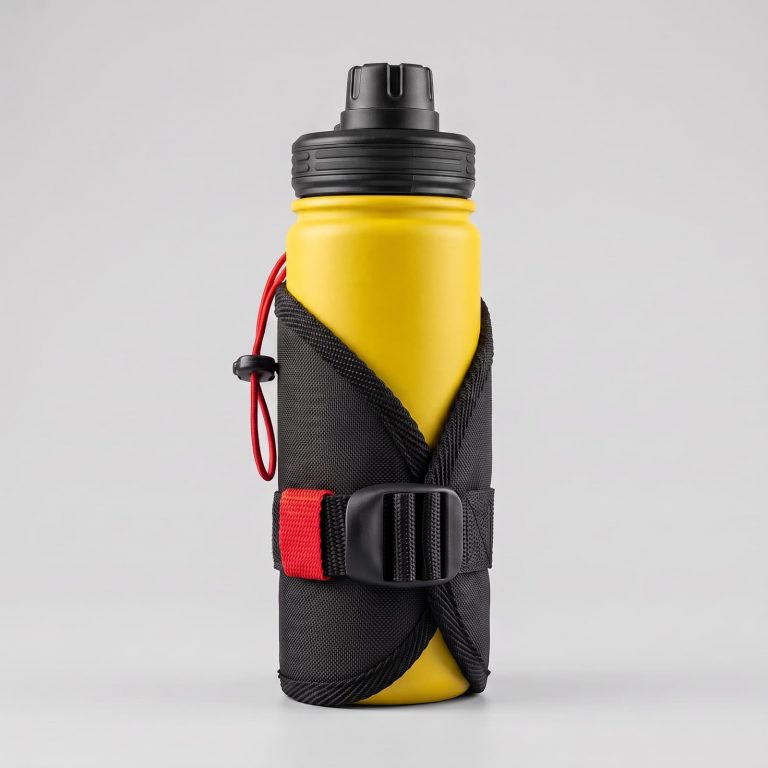
This was one of the observations behind mANEO.
Our first question was ridiculously simple:
Why is the water I need all day somewhere I cannot comfortably reach?
Carrying a bottle solves one problem.
Having the bottle immediately accessible solves another.
That became the starting point for our first product.
And it eventually became a broader design principle:
always at hand.
Things you repeatedly need while moving should be where you naturally need them.
The less you have to think about your equipment, the better that equipment is doing its job.
The Camino is not an outdoor advertisement
There is something else we love about the Camino.
It isn’t perfect.
It is ancient stone walls beside vending machines.
Beautiful churches and plastic chairs.
Dust.
Mud.
Cheap coffee.
Wet backpacks.
Laundry hanging between bunk beds.
A €12 pilgrim menu.
A bottle of wine shared by people who didn’t know one another three days ago.
A sunrise nobody planned to see.
The Camino can be beautiful and ugly within five minutes.
That is precisely why it feels real.
You don’t need to look like an adventurer.
You simply need to walk.
Santiago
Eventually the arrows lead to Santiago.
After days or weeks of imagining that moment, you enter the city and finally reach the cathedral.
People hug.
People laugh.
People cry.
Some go to Mass.
Some collect their Compostela.
Some sit down in the Praza do Obradoiro and simply look.
And then comes one of the Camino’s beautiful contradictions.
You spent all this time trying to reach Santiago.
Only after arriving do you realise how little of the story actually happened there.
It happened somewhere on the road.
During a conversation.
During the rain.
At a village café.
On the hill you thought you couldn’t climb.
When somebody helped you.
When you helped somebody else.
When you discovered that you could keep walking.
Santiago gives the journey a destination.
The road gives it meaning.
And after Santiago?
Perhaps that is why so many people return.
Another Camino.
Another trail.
Another country.
Because what people discover on the Camino is not exclusive to Spain.
Walking changes our relationship with distance.
Carrying our possessions changes our relationship with possessions.
Depending occasionally on strangers changes our relationship with strangers.
Moving slowly changes our relationship with the world around us.
The Camino simply provides an extraordinary place to discover these things.
More than a thousand years of history lie beneath your feet.
There is a yellow arrow showing you where to go.
There is another village ahead.
And tomorrow morning, you put your backpack on again.
Maybe that is enough.
Buen Camino.